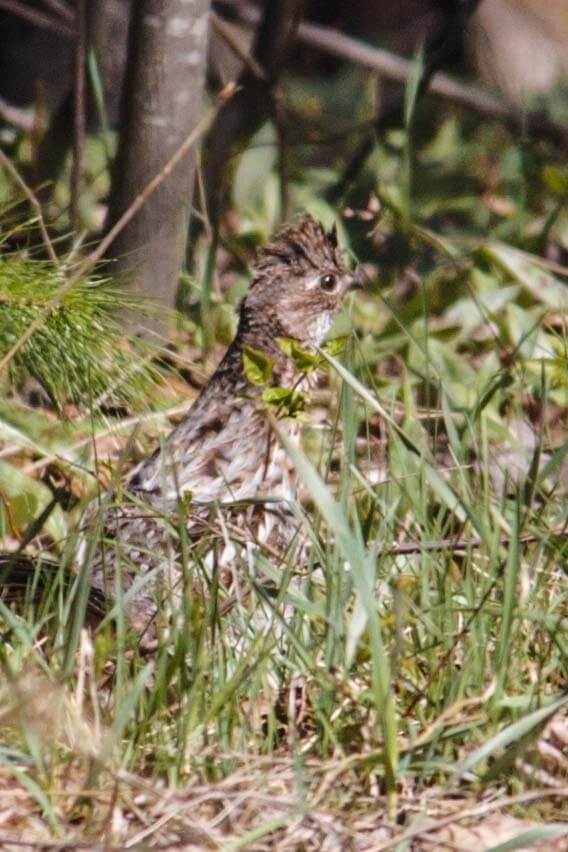
They are about as different as two species of animals could be. The ruffed grouse is a medium-sized upland bird weighing a pound to a pound and a half with a 25-inch wingspan. On the other hand, an elk is a massive mammal about five feet tall (at the shoulder), eight feet long (nose to tail) and can weigh close to a thousand pounds. Its antlers alone can be 40 times heavier than a single grouse.
Both are native to Pennsylvania. Both share the same forestland. And both need quality habitat, even shared habitat, to thrive.
With those desires in common, the Rocky Mountain Elk Foundation and Ruffed Grouse Society & American Woodcock Society entered into a three-year agreement in 2023 to pool their combined energy and resources for a series of projects within priority areas of Pennsylvania as well as Kentucky, Michigan, North Carolina, Tennessee, Virginia and Wisconsin. Such work benefits both species plus many others of all shapes and sizes.
Once such collaborative project, that since pulled in The Nature Conservancy and other partners, received a $450,000 grant from the U.S. Forest Service’s Landscape Scale Restoration Program. The goal is to implement treatments creating a mosaic of habitat through timber management, prescribed fire and other projects that reduce the risk of high-intensity fire and enhance forage.
“You need stands that are about 5 to 10 years old, with thousands of stems per acre,” Ben Larson, Ruffed Grouse Society Mid-Atlantic forest conservation director, told the Pittsburgh Post-Gazette. “It looks like a thicket and is hard to walk through. That’s important because the chicks need to eat insects, and that really thick vegetation not only provides them via plant diversity but also protects the chicks and hens from the raptors that otherwise would prey on them. So, it offers both protection and food diversity, food quality.”
“One of our highest priorities as an organization is to increase active forest management both in the West and in the Eastern United States,” Blake Henning, RMEF chief conservation officer, told the Pittsburgh Post-Gazette. “And Pennsylvania has always really been a core state for us. But we’re doing some of this in Virginia and West Virginia and North Carolina and Tennessee and Kentucky, too. We’ve kind of really focused on some of the Appalachian area where we’ve got restored elk herds and they’re expanding and they need quality habitat to continue that expansion.”
Work is planned for the Weiser and Sproul State Forests.
(Photo credit: Rocky Mountain Elk Foundation)